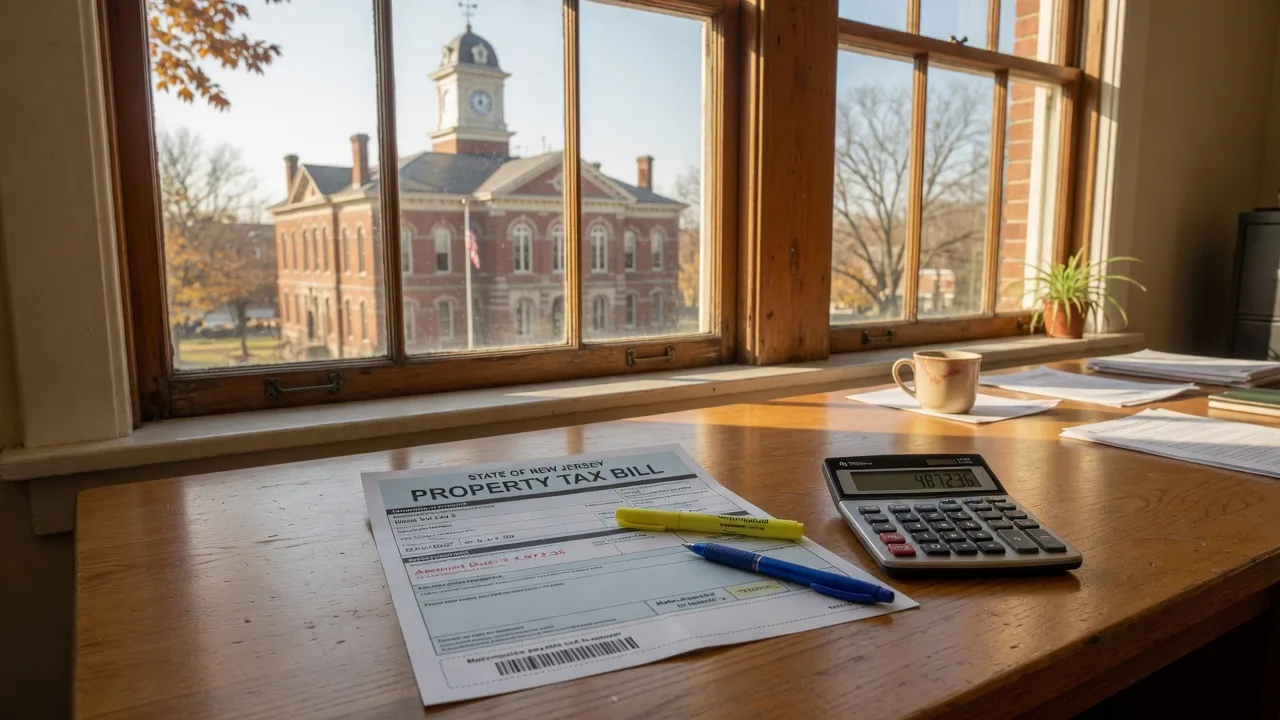
Property Tax Appeals
in New Jersey
New Jersey has the highest property taxes in the country. If you believe your assessment is too high, you have the right to appeal. This guide walks you through the process, deadlines, and evidence you need to make your case.
New Jersey has the highest property taxes in the United States. The average effective property tax rate in the state is about 2.4 percent, more than double the national average of roughly 1.1 percent. For homeowners in Burlington County, Camden County, and Gloucester County, property tax bills are often the largest ongoing expense of homeownership, even surpassing the monthly mortgage payment.
The good news is that you are not powerless. If you believe your property is assessed at too high a value compared to similar homes in your town, you have the right to appeal. And the process is more accessible than most homeowners realize. I have helped hundreds of families understand their tax bills, and I have seen firsthand how a successful appeal can save homeowners thousands of dollars over time.
This guide walks you through the entire property tax appeal process in New Jersey, from understanding how your assessment is calculated to gathering evidence, filing your appeal, and what to expect at each step. Whether you are considering an appeal or just want to understand your tax bill better, this information will help you make an informed decision.
How New Jersey Property Taxes Work
Before you can appeal your property taxes, you need to understand how they are calculated. The system has a few moving parts, and knowing them helps you build a stronger case.
In New Jersey, the law requires each municipality to assess all properties at the same percentage of true market value. This percentage is called the assessment ratio. Ideally, it should be 100 percent, meaning all properties are assessed at their full market value. In practice, most municipalities have not done a full revaluation in years, so assessments are based on a historical ratio. The important thing is not the ratio itself, but whether it is applied consistently across all properties. If your home is assessed at a higher ratio than similar homes, you are paying more than your fair share.
The equalization rate is a number set by the county to ensure that properties in different municipalities are taxed fairly relative to each other. It is calculated by dividing the total assessed value of all properties in a municipality by their total true market value. If your town has an equalization rate of 80 percent, it means the average property is assessed at 80 percent of its market value. The equalization rate is used to determine your share of county taxes, and it also affects the cap on how much your assessment can increase during a revaluation.
Your tax bill is calculated by dividing the total amount of revenue needed by the municipality, school district, and county by the total assessed value of all taxable property in the municipality. The result is a tax rate per $100 of assessed value. If your town needs $10 million and the total assessed value is $500 million, the tax rate is $2.00 per $100. A home assessed at $250,000 pays $5,000. Understanding this formula helps you see why an appeal can lower your bill: if your assessment is reduced, you pay less even if the tax rate stays the same.
Burlington County, Camden County, Gloucester County
Property tax rates and assessment practices vary across South Jersey. Understanding how your county works helps you tailor your appeal strategy.
Burlington County
Burlington County is the largest county in New Jersey by area, and property tax rates vary significantly by municipality. Towns like Moorestown and Mount Laurel tend to have lower effective tax rates because of their higher property values. Towns with lower average home values or higher school funding needs may have higher rates. Many municipalities in Burlington County have not done a full revaluation in 10 to 20 years or more, which means assessments may not reflect current market conditions. This creates opportunities for appeals, especially in areas where home values have not kept pace with the rest of the town. The Burlington County Board of Taxation handles appeals for properties assessed under $1 million.
Camden County
Camden County has a mix of urban, suburban, and rural communities. Property tax rates tend to be higher in towns with lower property values, reflecting the need to fund schools and services from a smaller tax base. Camden City and surrounding communities have different assessment dynamics than the more suburban towns like Cherry Hill or Haddonfield. The Camden County Board of Taxation handles appeals for properties under $1 million. If you live in Camden County, pay close attention to the equalization rate, as it can significantly affect your appeal strategy.
Gloucester County
Gloucester County has experienced significant growth in recent years, with new construction and rising home values. This creates both opportunities and challenges for tax appeals. In rapidly appreciating areas, assessments may lag behind market values, which could make an appeal less likely to succeed. But in areas where values have not risen as quickly, or where assessments were recently updated, there may be grounds for an appeal. The Gloucester County Board of Taxation handles appeals for properties under $1 million. Check with your municipal assessor to understand when the last revaluation occurred in your town.
When You Might Have Grounds for an Appeal
Not every high tax bill is appealable. The basis for an appeal is that your assessment is too high compared to similar properties, not that your taxes are too high in general. Here are the situations where an appeal makes sense.
This is the most common basis for an appeal. If your property is assessed at a higher value than its true market value, you have grounds for an appeal. You need evidence, typically comparable sales of similar properties in your neighborhood that sold for less than your assessment. If three similar homes on your street sold for $350,000 to $375,000 but your home is assessed at $400,000, you have a strong case for overvaluation.
If your assessment is a higher percentage of market value than the assessments of similar properties in your town, you have grounds for a discrimination appeal. This is often the strongest argument because it relies on the principle of uniformity. You need to show that your assessment ratio is higher than the average ratio for comparable properties. This requires gathering assessment data on similar homes and comparing the ratios.
Sometimes the assessor has incorrect information about your property. If your tax record shows the wrong square footage, number of bedrooms, lot size, or condition, your assessment may be based on faulty data. This is the easiest type of appeal to win because it is a factual correction. Check your property tax card at the municipal assessor's office. If the data is wrong, ask for a correction. This alone can sometimes reduce your assessment.
The Appeal Process
The property tax appeal process in New Jersey has three main levels. Most homeowners resolve their case at the first level, the County Board of Taxation. Here is how each level works.
Informal Review with the Assessor
Before filing a formal appeal, contact your municipal tax assessor. Many issues can be resolved informally. The assessor can explain how your assessment was determined and may agree to adjust it if your evidence is compelling. This saves everyone time and paperwork. Be polite, prepared, and professional. Bring your evidence and explain your case clearly. I have seen this work for homeowners who simply took the time to understand their assessment and present their case.
County Board of Taxation
If the informal review does not resolve the issue, you can file a formal appeal with the County Board of Taxation. This is the most common route for residential properties. The filing deadline is April 1 of the tax year, or 45 days from the date your tax bill was mailed. The filing fee is typically $25 to $50. You will need to complete a form (State Form PTR or your county's equivalent) and attach your evidence. The board will schedule a hearing, which may be conducted in person or by submission of written evidence. Most counties offer a structured process that is manageable for homeowners without an attorney.
New Jersey Tax Court
If you are dissatisfied with the County Board's decision, or if your property is assessed at over $1 million, you can appeal to the New Jersey Tax Court. This is a more formal process that typically requires legal representation. The Tax Court hears cases from all 21 counties and provides a judicial review of the assessment. The deadline to appeal to the Tax Court is 45 days from the County Board's decision. For most homeowners, the County Board level is the right place to resolve the issue.
Timeline and Deadlines
The most common reason homeowners lose their right to appeal is missing the deadline. The property tax appeal calendar in New Jersey has specific windows that you need to know.
April 1 Filing Deadline
For most municipalities in New Jersey, the deadline to file a property tax appeal is April 1 of the tax year. This is a hard deadline. Missing it means you have to wait until the next year. If your municipality has a different tax calendar, you have 45 days from the date the tax bill is mailed. Check with your municipal tax assessor to confirm which deadline applies to your town. I recommend starting the process at least two months before the deadline to give yourself time to gather evidence and prepare your case.
What Happens After You File
After you file your appeal, the County Board of Taxation will schedule a hearing. This typically happens within a few months. You will receive a notice of the hearing date. At the hearing, you present your evidence, and the municipal assessor presents theirs. The board may make a decision on the spot or take the case under advisement. If the board approves your appeal, the reduced assessment is applied to the current tax year, and you may receive a refund for taxes already paid. If the board denies your appeal, you have 45 days to appeal to the New Jersey Tax Court.
How to Gather Evidence
The strength of your appeal depends on the quality of your evidence. Here is what you need and where to find it.
This is the most important evidence. You need recent sales of properties similar to yours in size, age, condition, and location. Aim for three to five comparable sales from the past year. You can find this data through your county's online property records, the assessor's office, or real estate websites. Look for homes that are within a half-mile of your property and have similar square footage, bedroom count, and lot size. The closer the comparables, the stronger your case.
If your property has issues that affect its value such as a cracked foundation, roof damage, water damage, outdated systems, or deferred maintenance, take photographs. These images help demonstrate that your property is not in the same condition as similar properties that sold for higher prices. Be thorough and document every issue that a buyer would consider when making an offer.
Request the assessment records of comparable properties from your municipal assessor's office. This information is public record. Compare your assessment to the assessments of similar homes. If your home is assessed at a higher value than similar homes, note the difference. This is the core of a discrimination appeal. The assessor's office can provide you with the assessment cards for comparable properties, which show the assessed value of the land and improvements separately.
A professional appraisal is the strongest evidence you can provide. It costs $400 to $600 but carries significant weight with the County Board of Taxation. A licensed appraiser will evaluate your property and provide a written opinion of its market value based on comparable sales, property condition, and market analysis. If the appraisal comes in significantly below your assessment, it is compelling evidence. For higher-value properties or complex cases, an appraisal is often worth the investment.
Should You Hire a Tax Attorney or Go It Alone?
The decision to hire a professional depends on the complexity of your case, your comfort level with the process, and the potential savings. Here is how to think about it.
Go It Alone When
- Your case is straightforward (comparable sales clearly show overvaluation)
- You are comfortable gathering evidence and presenting your case
- The potential savings are modest (under $500 per year)
- Your property is assessed under $1 million
Hire a Professional When
- Your property is assessed at over $1 million (must go to Tax Court)
- The potential savings are significant (over $1,000 per year)
- Your case is complex (unique property features, recent revaluation)
- You prefer to have an expert handle the paperwork and hearing
Frequently Asked Questions
Honest answers to the questions South Jersey homeowners ask most about property tax appeals.
What is the deadline for filing a property tax appeal in New Jersey?
Do I need a lawyer to file a tax appeal?
How much does it cost to file a tax appeal?
What evidence do I need for a tax appeal?
Can I appeal my property taxes if my home value went down?
What happens if my appeal is successful?
Key Takeaways
The basis for an appeal is that your assessment is too high compared to similar properties, not that your taxes are too high in general.
The standard deadline for filing is April 1. Start gathering evidence at least two months before the deadline.
Comparable sales data is your strongest evidence. Aim for three to five recent sales of similar homes in your neighborhood.
Start with an informal review of your municipal assessor. Many cases can be resolved without a formal appeal.
For most homeowners, representing yourself at the County Board of Taxation is a practical and cost-effective approach.
Not Sure If You Have a Case?
Every property is different. Use Ask Bob to get a straightforward answer about whether an appeal makes sense for your home. No pressure, just honest guidance.
Related Articles
These guides will help you continue building your homeowner knowledge.
Homeowner's Insurance Guide
What standard insurance covers, what it does not, and how to choose the right coverage for your home.
Read ArticleUnderstanding Your Mortgage Statement
Breaking down principal, interest, escrow, and how extra payments affect your payoff timeline.
Read ArticleUnderstanding Your Property Taxes
How NJ property taxes work, how to read your tax bill, and when to appeal in Burlington County.
Read Article