Electrical Issues
Every Homeowner Should Know
Electrical problems are not something to ignore or guess about. Knowing the warning signs and when to call a professional can protect your home and your family. Here is what every homeowner needs to know.
Electricity is the system we rely on most and understand the least. We flip a switch and the lights come on. We plug in a device and it charges. But when something goes wrong, the risks are serious: fire, shock, and damage to your home and appliances.
According to the National Fire Protection Association, electrical failures or malfunctions are a leading cause of home fires in the United States. Most of these fires are preventable. The warning signs are there, but they are easy to miss if you do not know what to look for.
This guide covers the most common electrical issues homeowners face, the warning signs that require immediate attention, and the safety basics every homeowner should know. None of these are DIY projects beyond the simplest fixes. When it comes to electricity, knowing when to call a professional is the most important skill you can develop.
Warning Signs of Electrical Problems
These are the most common signs that your home's electrical system needs attention. If you notice any of these, call a licensed electrician.
Flickering or Dimming Lights
Occasional flickering when a large appliance kicks on, like an air conditioner or refrigerator, can be normal. But if lights flicker regularly, dim when you use specific appliances, or flicker throughout the house at the same time, you may have a loose connection, an overloaded circuit, or a problem with your main electrical panel. This is worth investigating. A loose connection in your panel or wiring can cause arcing, which generates heat and can start a fire. Call an electrician to diagnose and fix the issue.
Warm or Discolored Outlets and Switches
Touch your outlets and light switches occasionally. If any feel warm to the touch, or if you notice discoloration, scorch marks, or melting around the edges, you have a problem. Heat is a sign of resistance in the electrical connection, which can lead to arcing and fire. Stop using the outlet immediately and call an electrician. Do not cover it with furniture or ignore it. This is one of the most common warning signs of an electrical fire hazard.
Burning Smells from Outlets or Switches
A burning smell that is not coming from the kitchen or a nearby candle is a genuine emergency. If you smell something like burning plastic or fish near an outlet, switch, or your electrical panel, turn off the power to that area at the breaker box and call an electrician immediately. The smell is likely from melting wire insulation or overheated components. Do not use the outlet or circuit until a professional has inspected it.
Frequently Tripped Breakers or Blown Fuses
A breaker that trips occasionally is doing its job, protecting your home from an overloaded circuit. But if a breaker trips frequently, it is a sign that something is wrong. The circuit may be overloaded, meaning you have too many devices plugged into it. Or there may be a short circuit, a ground fault, or a failing appliance. If you have a breaker that trips regularly and you are not overloading the circuit, call an electrician. Do not keep resetting it without investigating the cause. Each time a breaker trips, it wears the mechanism slightly.
Sparkling or Crackling Sounds
If you hear crackling, buzzing, or sparking sounds from outlets, switches, or your electrical panel, you have an arcing problem. Arcing is when electricity jumps across a gap in a connection, generating intense heat. It is a leading cause of electrical fires. Turn off the affected circuit and call an electrician immediately. Do not use the outlet or switch until it has been inspected and repaired.
When to Stop and Call an Electrician Immediately
Some electrical issues require immediate action. Do not wait, do not investigate further. Call an electrician right away.
Burning smell from any outlet, switch, or panel
Turn off the circuit and call an electrician. This is a fire risk.
Visible sparks from an outlet or switch
Stop using the outlet and call an electrician. Sparks indicate arcing.
Shocks or tingling from appliances
A shock when touching an appliance indicates a grounding problem. Call an electrician.
Main breaker repeatedly tripping
If the main breaker for your whole house keeps tripping, you have a serious issue. Call an electrician.
Warm or hot electrical panel cover
If the metal cover on your breaker panel feels warm, there is excessive heat inside. Call an electrician immediately.
Flickering lights combined with any other symptom
Flickering lights plus warm outlets, or flickering plus a burning smell, is a double warning sign. Call an electrician.
Basic Electrical Safety
These safety devices and practices are essential for every home. If your home is missing any of these, make them a priority.
GFCI Outlets
Ground Fault Circuit Interrupter (GFCI) outlets are designed to protect you from shock by cutting power when they detect a ground fault. They are required in bathrooms, kitchens, laundry rooms, garages, basements, and outdoor locations. GFCI outlets have "Test" and "Reset" buttons on the face. Test them monthly by pressing the Test button (the outlet should click and the power should cut off), then press Reset to restore power. If an outlet does not trip when tested, or if it trips and will not reset, replace it. GFCI outlets cost $15 to $25 at any hardware store and can be installed by a qualified electrician. If your home was built before the 1970s, you may have outlets that are not grounded. A licensed electrician can evaluate your options, including GFCI protection.
Smoke Detectors
Smoke detectors should be installed on every level of your home, inside each bedroom, and outside each sleeping area. New Jersey law requires working smoke detectors in all residential units. Test them monthly by pressing the test button. Replace batteries at least once a year, or when you hear the low-battery chirp. Replace the entire smoke detector unit every 10 years. The manufacture date is printed on the back. If you cannot find a date, assume it is older than 10 years and replace it. For interconnected smoke detectors, when one goes off, they all go off, which is the safest configuration. If your detectors are not interconnected, consider upgrading when you replace them.
Carbon Monoxide Detectors
Carbon monoxide (CO) is an odorless, colorless gas that can be deadly. New Jersey law requires CO detectors on every level of your home. If you have a gas furnace, gas water heater, gas stove, fireplace, or attached garage, CO detectors are essential. Test them monthly and replace batteries annually. Replace the entire unit every 5 to 7 years, depending on the manufacturer's recommendation. Combination smoke and CO detectors are available and simplify maintenance. If your CO detector alarms, evacuate the home immediately and call 911 from outside.
Extension Cord Safety
Extension cords are for temporary use only. They are not a permanent solution for running appliances or lighting. If you find yourself relying on extension cords because you do not have enough outlets, have an electrician install additional outlets. Using extension cords as permanent wiring is a fire hazard. Never daisy-chain extension cords or power strips. Never run extension cords under rugs, through doorways, or across walkways where they can be damaged. And never use an indoor extension cord outdoors. Outdoor-rated cords have heavier insulation and are designed to withstand the elements.
Understanding Your Breaker Box
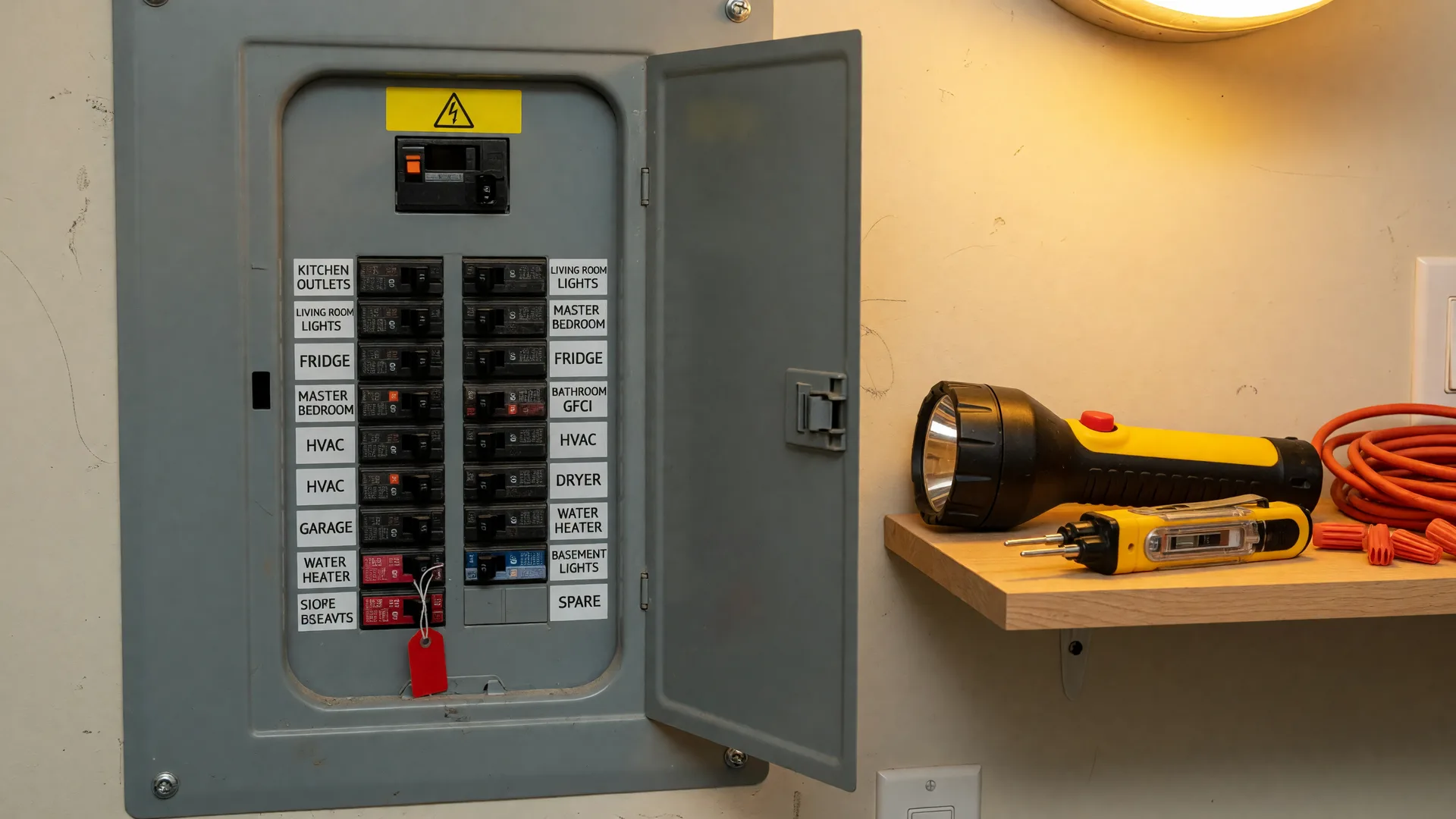
Your electrical panel (breaker box) is the heart of your home's electrical system. Knowing how it works and what to look for is essential for every homeowner.
Open your panel and look at the labels on the inside of the door. Are they clear and accurate? If not, take an afternoon to map and label every breaker. Turn off each breaker one at a time, walk through your home to see what loses power, and write it down. This is an essential safety task. In an emergency, you need to know exactly which breaker to turn off. A well-labeled panel saves time and prevents confusion when every second counts.
The main breaker rating tells you how much electrical capacity your home has. Most modern homes have 200-amp service. Older homes may have 100-amp or even 60-amp service. If your home has 100-amp service and you are planning to add major appliances, electric vehicle charging, or a home addition, you may need to upgrade to 200-amp service. This is a significant project but is often necessary for modern electrical demands. A licensed electrician can evaluate your current usage and make recommendations.
Modern electrical codes require AFCI breakers in most living areas. These breakers detect dangerous arcing conditions and shut off power before a fire can start. If you have an older panel without AFCI breakers, consider upgrading. An electrician can install AFCI breakers on the circuits that need them. This is a relatively modest investment for significant fire safety improvement.
When a breaker trips, first unplug or turn off the devices on that circuit. Then, reset the breaker by flipping it fully to the OFF position and then back to ON. If it trips again immediately, there is a short circuit or ground fault that requires an electrician. If it holds, plug devices back in one at a time. If it trips when you plug in a specific device, that device is likely faulty. If it trips when you use multiple devices together, the circuit is overloaded and you need to redistribute the load.
When Your Panel Needs Upgrading
Here are the signs that your electrical panel may need to be upgraded.
If your main breaker trips regularly during normal household use, your panel may be undersized for your needs. This is common in older homes where the electrical demands have grown far beyond what the original system was designed for. Modern homes have many more devices and appliances than homes built 30 or 40 years ago.
If you are adding a central air conditioner, electric vehicle charger, heat pump, hot tub, or electric tankless water heater, your panel may need to be upgraded to accommodate the additional load. A 200-amp service is the modern standard for homes with these appliances. An electrician can perform a load calculation to determine if your current service is adequate.
If your home has a Federal Pacific Stab-Lok or Zinsco electrical panel, it should be replaced. These panels have known safety issues and are considered fire hazards. Many insurance companies will not insure homes with these panels, or they require them to be replaced as a condition of coverage. A licensed electrician can identify these panels and provide a replacement estimate. Replacement costs $1,500 to $3,000 depending on the scope of work.
If your panel is full and you need to add a new circuit for a renovation or new appliance, you have a few options. An electrician may be able to install tandem breakers (which fit two circuits in one slot) if your panel supports them, or they may recommend installing a sub-panel or upgrading to a larger main panel. This is a common situation in older homes.
South Jersey Permit Requirements for Electrical Work
Electrical work in New Jersey is regulated for a reason. Here is what you need to know about permits and licensing.
In New Jersey, a permit is required for most electrical work, including adding new circuits, installing new outlets or switches, upgrading your panel, running new wiring, and installing major appliances. Minor repairs like replacing an existing outlet or switch (if the wiring is not modified) may not require a permit, but check with your local building department to be sure. The rules vary by municipality. In Burlington County, towns like Moorestown, Mount Laurel, and Delran each have their own permitting requirements.
Your electrician should pull the permit and schedule the inspection. This is part of their responsibility as a licensed contractor. If a contractor tells you a permit is not needed or asks you to pull the permit yourself, question their motives. A permit ensures the work is inspected and meets code. It protects you, your home, and your insurance coverage. Never let unpermitted electrical work be done on your home. It can cause issues when you sell and may not be covered by your insurance if something goes wrong.
Homeowners in New Jersey can pull permits for electrical work on their own primary residence, but the work must still pass inspection. This is only recommended for homeowners with significant electrical experience. If you are not a trained electrician, hiring a licensed professional is the safer and more reliable choice. The cost of a permit is typically $50 to $200 depending on the scope of work, and it is a small price for the safety and peace of mind that comes with code-compliant work.
Home Inspector Electrical Findings and What They Mean
As someone who has been through over 600 real estate transactions, I have seen the same electrical issues come up in home inspections again and again. Here are the most common findings and what they mean for you as a homeowner.
This is one of the most common inspection findings in older homes. A three-prong outlet that is not actually grounded is a safety hazard. It means the outlet has no ground wire, which means surge protectors will not work and there is a higher risk of shock. The fix is either to properly ground the outlet (which requires running a ground wire to the panel) or to replace it with a GFCI outlet, which provides protection without a ground wire. This is a job for a licensed electrician.
This means the hot and neutral wires are connected to the wrong terminals on an outlet. It is a simple fix but can be dangerous because it leaves power on even when the switch is off. An electrician can correct this in minutes. It is a common finding in older homes and DIY electrical work.
Inspectors always check that GFCI outlets are installed in bathrooms, kitchens, garages, basements, and outdoor locations. Missing GFCI protection is a common finding in older homes. The fix is straightforward: install GFCI outlets or GFCI breakers. This is a relatively inexpensive upgrade that significantly improves safety. Most electricians can install several GFCI outlets in a few hours.
This is when two wires are connected to a single breaker terminal. It is a common DIY mistake and can create a loose connection that leads to arcing and fire. The fix depends on whether the breaker is designed to accept two wires. If not, an electrician can install a new breaker or add a pigtail connection. This is a quick fix for a professional.
If your home was built before 1940, it may have knob-and-tube wiring. This is an outdated system that lacks a ground wire and is not designed for modern electrical loads. Many insurance companies will not insure homes with active knob-and-tube wiring, or they require it to be replaced. If you have knob-and-tube wiring, have a licensed electrician evaluate it and provide a replacement estimate. Rewiring a home is a significant project but is often necessary for safety and insurance.
Key Takeaways
Flickering lights, warm outlets, burning smells, and frequently tripped breakers are warning signs that require professional attention. Do not ignore them.
Test your GFCI outlets and smoke detectors monthly. Replace smoke detectors every 10 years and CO detectors every 5 to 7 years.
Label every breaker in your panel. In an emergency, you need to know exactly which breaker to turn off. A well-labeled panel saves time and prevents confusion.
All electrical work in New Jersey requires a permit and must be performed by a licensed electrical contractor. Never accept unpermitted work.
If your home has a Federal Pacific or Zinsco panel, or knob-and-tube wiring, have it evaluated by a licensed electrician. These are known safety hazards that may affect your insurance.
Have an Electrical Question?
Not sure if an electrical issue needs immediate attention? Ask Bob for an honest opinion. Or find a trusted electrician through the HomeCircle Trusted Partners directory.
Related Handbook Articles
When to DIY vs. Call a Professional
A practical framework for deciding home repair strategy, with cost comparisons and licensing rules.
Read ArticleFinding Reliable Contractors in South Jersey
How to vet, hire, and work with trustworthy contractors, including electricians.
Read ArticleSetting Up Your Home Maintenance Schedule
Monthly, seasonal, and annual checklists to keep your whole home running smoothly.
Read Article